|
Food for Badgers

Badgers and fresh Water
Badgers tend to get most of the water they need to survive from the food they
eat. However, they can be at risk of dehydration if they can not get enough wet
food to eat (i.e. if the weather is too hot and dry; or during long freezing
periods). In these circumstances, putting out a large metal tray of fresh water
can help badgers get enough to drink.
Badger cubs may have slightly different needs than adults. If you have cubs
visiting, water can be invaluable for them. One cause of cub death is
coccidiosis (this is an intestinal inflammation caused in badgers by Eimeria
melis and Isospora melis. As these parasites reproduce, they
cause serious intestinal bleeding, which leads to very watery
diarrhoea. Consequently, the cub loses substantial amounts of water as well as
salts and various nutrients. Most adult badgers will have developed an immunity
to this, but cubs will not have developed an immune response. A good springtime
water supply can be vital for badger cubs. In a sense, for cubs at risk in the
spring and early summer, a clean water supply water may be more important than
food.
|
Academic Note: |
|
Journal of Animal Ecology |
|
Feeding Specialization of the European Badger Meles
meles in Scotland |
|
H. Kruuk and T. Parish © 1981 British Ecological
Society. |
|
Abstract |
|
(1) The food of European badgers Meles meles L. is
described from six areas in Scotland, using faecal analysis. The
estimated relative volume of various foods in the diet is compared with
the frequency of their occurrence. Variation between areas and
differences between seasons are related to food availability, and the
food diversity and variance of different foods with time are presented.
|
|
(2) The dominant food everywhere was earthworms,
Lumbricus terrestris L. and L. rubellus Hoffmeister but their importance
in the diet varied little in time and between areas, and there was no
correlation with availability. Other less important foods included
rabbits, cereals, insects and tubers, and several minor food categories;
they were consumed relative to availability in those cases where this
availability could be measured. |
|
(3) It is suggested that badgers change their
foraging effort to compensate for fluctuations in earthworm
availability, consuming a range of secondary foods opportunistically. |
|
Academic Note: |
|
Food habits and trophic niche overlap of the badger
(Meles meles L.) and the red fox (Vulpes vulpes L.) in a Mediterranean
coastal area. |
|
Ciampalini, B | Lovari, S |
|
Zeitschrift fuer Saeugetierkunde [Z. SAEUGETIERKD.].
Vol. 50, no. 4, pp. 226-234. 1985. |
|
Studied the diets of badgers (Meles meles ) and red
foxes (Vulpes vulpes ) in a coastal area of West-central Italy, using
faecal analysis, throughout a year. Both volume and frequency of
occurrence of different foods were quantified. Arthropods were the
staple of both species in spring and summer whereas fruits were the most
important resource in autumn and winter. The diet overlap of badgers and
foxes proved very extensive, in spite of minor differentiating details.
|
| RSPB Spotlight on Badgers book |
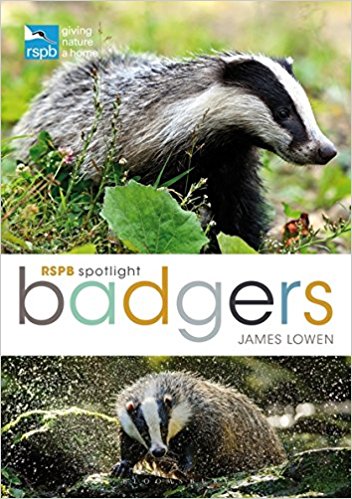 |
James
Lowen explores the lives of badgers and their communal
living, feeding habits and threats to their conservation. Click
here to buy:
Paperback edition
Kindle edition
|
|