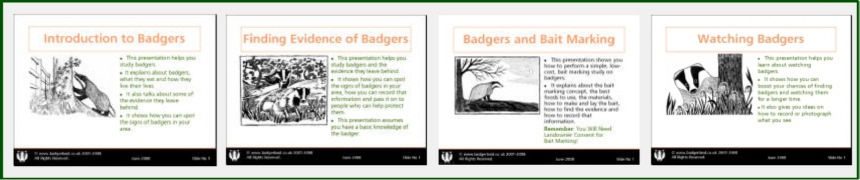
Introduction to Badgers
Latin Name: Meles meles

This
topic is a quick summary of the badger. There are a few paragraphs of
information which gives information about the "basics" of a badger. There is
much more detail on each aspect of the badger in the more detailed topics shown
in the menu on the left of this screen.
Names
The badger we have in the UK is really the Eurasian badger (meles meles). It
is called Eurasian because it lives in the UK, Europe and parts of Asia. Our UK
badger is not the same species as the American Badger (which lives in Canada and
the USA) or the Honey Badger (which lives in Africa, and isn't really a true
badger anyway).
Many people think that the reason it is called a "badger" because this is
similar to the French word "beucher", which means digger. Another option is that
because it has a very obvious black and white face, this is like a mask or a
badge; so it is called badger.
Other nicknames in the UK include Brock, Pate and Bawson. The word Brock
probably comes from the very early Celtic word brokkos, which means
grey. The word Bawson may also come from the old French word bausent,
which means "piebald, having a coat with black and white patches".
The scientific names Meles meles is used across the world; as our badger has
different names in different countries and different languages. Some of the
non-English names include:
- Broch = Scots Gaelic
- Mochyn Daear (earth pig) = Welsh
- Beucher = French
- Dachs = German
- Das = Dutch
- Svintoks = Norwegian
- Grävling = Swedish
- Tasso = Italian
- Toixó = Catalan
- Tejón = Spanish
- Texugo = Portuguese
- Borsuk = Polish
Size
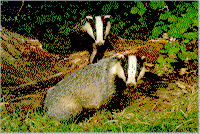 An
adult male badger measures from 690 - 800mm from the head to the base of
the tail - plus a 125 - 175 mm tail, and weighs 8.5 - 12.5 kg. An
adult male badger measures from 690 - 800mm from the head to the base of
the tail - plus a 125 - 175 mm tail, and weighs 8.5 - 12.5 kg.
An adult female badger measures from 670 - 790mm from the head to the base of
the tail - plus a 115 - 190mm tail, and weighs 8.2 - 10.5kg. Breeding females
may weigh as little as 7.2kg during lactation.
As seen from these numbers, the female badger is slightly smaller than the male.
The male has a
slightly broader head and looks a little more muscular. The females tend
to have a more obviously bushy tail; whereas the males tend to have a
thinner pointed tail which has a little more white on it.
It is pretty clear when you see a badger from the side, that it has a small
head, a thick short neck, a wedged-shaped body, short stubby legs and a short
tail. It has a strong rubbery nose and an amazing sense of smell. It can
lift it's nostrils out of the way to make sure it does not get a noseful of
soil. The badger does not see very well as it only has small eyes. It can only
see in monochrome (black and white). It's ears are
small and close to the head; and are tipped with white fur.
The front legs, feet and claws are immensely strong, making it obvious that
the badger is a very powerful digging machine. Like with humans, the badger has
feet which are adapted so that the toes and the metatarsal bones (the long bones
in the feet), rest on the ground. This means that the badger has a
plantigrade-type foot. This type of foot provides stability and a good
weight-bearing ability; as plantigrade feet have a large surface area. The
disadvantage stems from the fact that this type of foot is heavy and has a lot
of complex joints; which makes it difficult to move rapidly.
When walking on soft ground, the footprint will show the claw marks, the toe
pads, the central pad and the heel (ie. plantigrade-style). On firmer ground,
the heel print is often missing; so, in this sense, the badger does not have the
feet of a "pure" plantigrade.
Pelage/fur
Their coarse coat of hair is black and white - leading to a grey appearance from a
distance. The hair from their back is up to 75mm long and has a black
pointed tip.
The badger has a black chest and forepaws; with a prominent
black and white striped head with white ear-tips. Hair from the head,
face, legs and underside is shorter.
They do shed their hair, and it is often possible to find badger hair on or
in the soil at or near a badger sett. Badgers also undergo a seasonal moult -
where they tend to shed more hair in the summer (when there is more daylight and
higher temperatures), before growing more hair again at the start of the winter
(when the amount of daylight has reduced and the temperature is lower).
Habitat
It lives in or near the edge of woods and copses, especially if attached to pastureland.
Occasionally it can be seen in suburbs; and on the edge of farmland and in
abandoned quarries.
Badgers have a widespread distribution in the UK, with more in the
wild/wet areas of the south and south-west, and fewer in flat and farmed
areas, and above 900m. Given that they live underground, their setts are
normally dug into sloping ground which remains above the typical water
table, so are not normally abundant in flood-prone areas.
Activity
Badgers are primarily nocturnal because their prey (earthworms throughout
most of their range) only comes to the surface at night to breed. Generally,
here in the UK, badgers emerge from their setts (underground homes) before dusk
between May and August and after dark for the rest of the year; they are also
less active from November to February. They may emerge from their setts and
groom themselves (and one another) for a while before moving off to forage
nearby. They may travels hundreds of metres away from the sett in large
territories; but they will normally return to their home sett before dawn.
In the high summer months, they may emerge a short while before sunset.
Young
Mating usually occurs in July, but implantation can be delayed by 2 to
10 months. After then the badger is properly pregnant for about seven
weeks.
There is normally a single litter of between 2 and 3 cubs born from
January to March. The cubs are born with their eyes and ears closed, with dirty white fur on their
upper body only.
Many cubs die within their first year, although those that do survive,
often live for up to five years or more.
Nest
Badgers live in groups of up to 2 to 20 (but normally around 6) in an earthen sett. The sett is
lined with moss, grass and leaves which the badger renews frequently.
Often there will
also be a special outlier sett (containing fewer nesting chambers) about
100 metres or so away
from the main sett.
The sett will normally be in sloping ground near the edge of deciduous or
mixed woodland, with good access to grassland. In urban areas; they may live
under buildings where they have access to urban grassland or gardens. In rural
areas, they will also live in old quarry or mine workings or caves; as well as
in embankments (railway, road, canal) and in thick hedgerows.
Where badgers are commonly present in a landscape area, a reasonable sett
density is about 2 badger setts per square kilometre. This can be high in areas
of good badger habitat and high badger populations. It can be much lower in
areas of poor badger habitat.
Diet
Although the badger is classed as a carnivore (it has large canine
teeth), it is essentially omnivorous. As well as earthworms, beetles,
voles, mice, frogs, snails and wasps, it also eats acorns, beech mast,
bulbs, fruits and roots. Essentially it is a forager (eating what it
finds), rather than a hunter which chases after prey.
Compared to the fox, the badger has a longer gut to cope with it having a
more wide-ranging diet.
Voice
Badger cubs sometimes make a high-pitched whickering sound. Adults growl or bark as a
warning or purr with pleasure. They are also known to emit a long-drawn
scream (reason unknown). More details of the noises they make is on the
Sounds and
Detailed Badger Sounds pages.
Status
Generally the badger is well distributed across the UK, although it
remains as an illegally persecuted animal in too many areas.
Badgers have been described as the oldest land-owners in Britain. Long
before Britain was an island they were here.
They belong to the same family of mammals that have musk-bearing glands
under their tails - including
Otters,
Polecats,
Ferrets,
Mink,
Stoats,
Weasels,
Pine Martens
and Wolverines.
Predators
Many badgers are illegally killed by gamekeepers and farmers, cubs sometimes killed
by Dogs and
Foxes.
Other are killed by men who illegally hunt them for so-called sport - either by
shooting them with hunting rifles or allowing them to be killed by one or more terriers or other
large dogs.Many other badgers are killed in accidents on the roads and railways.
Badgers are a Key Species
Thousands of years ago, the UK contained populations of bears and wolves; and
there is little doubt that they preyed on badgers. However, now that bears and
wolves are extinct in the wild in Britain, badgers are pretty much at the top of
the ecological tree. They are a key species; who rightly deserve to maintain
their place in the ecology of Britain. Removing badgers from an area results in
major changes for the ecology of other species. The number of pests increase
without badgers, so rabbit, rat and mouse problems get worse. Fox numbers
increase, which leads to other protected wildlife species numbers falling
rapidly. In a very real sense, the presence of the badgers helps to keep fox
numbers down; which allows brown and mountain hares to maintain their relatively
low population levels.
Collective Names
Sometimes people often get confused between the name of a group
of badgers.
- The badgers which live together as a family-type group is
called a clan.
- The collective noun for a group of badgers is a cete.
| The Badger by the Mammal Society |
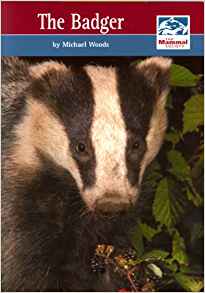 |
This
booklet is packed with facts about badgers. A great gift for any-one who wants to learn more about badgers. Click
here to buy:
The Badger by the Mammal Society |
|