Latin Stuff about Badgers

Classification History
In the 18th Century Carl Linnaeus published a
multi-volume System of Nature, in which he divided the natural world
into different categories. In simple terms, it was him who put different
animals into groups such as bears, cats, dogs, weasels, fish, etc.
Originally the badger was placed into the Ursidae family (i.e. bears),
but it is now clear that the badger is a true member of the weasel
family. The weasel family is one of the most diverse familes within the
larger order of carnivores.
Eurasian Badger
The British Badger is one of the better known badgers
across the world. More correctly, the British Badger should be known as
the European or Eurasian badger - because it lives in Europe and Asia
(including in some parts of China and even Japan).
Meles meles
The Scientific name for a "British" badger is Meles meles
(in the Melinae Sub-Family, part of the
Mustelidae family - all members of a group of animals called the
Carnivora). Although this would suggest that the badger is a carnivore,
it is actually an omnivore (meaning that it eats both meat and plants).
Animals are given scientific names so that experts can put
different species into related groups. For example:
-
Animals are classed as Mammals (part of the Mammalia
class).
-
Within this, animals are divided into Carnivores (part
of the Carnivora order of animals).
-
Within the Carnivores, animals are sub-divided again,
into Mustelids (part of the Mustelidae Sub-family).
-
Once again the Mustelids are divided into the main
Badgers Sub-family of Melinae.
-
The different species of true badger are then included
within this Melinae Sub-family. One such species is the
"British" (or Eurasian) badger, called Meles meles according
to its latin Genus.
If these names seem strange, it is because when most species
were first categorised by Carl Linnaeus, Latin
was the language which was used for science in those days. Although, we
use the term "Latin" names, the actual names may be based on Latin or
Greek.
The other reason for using an agreed scientific name for
an animal species, is that the same species may live in different
countries and may have different names, based on different languages or
different human history. The Eurasian badger (meles meles) is called a
badger in the UK, but is called Blaireau or Beucher in France, Tejon in
Spain, Texugo in Portugal, Mochyn Daear (from earth pig) in Welsh,
Weasel Family
Other animals in the Mustelids, include
Weasels,
Stoats,
Polecats,
Ferrets,
Mink and
Pine Martens. This may seem a bit surprising at first, because most weasel-like
animals have long, thin bodies and long tails. Badgers (like
Otters and
Wolverines) look
very different, with their short stocky bodies, short tails and short
powerful legs (they look more like small bears). However, in common with
other weasel-like animals, badgers have long strong claws on their front
feet - though these are designed for digging, and not scampering through
the tree-tops. Unlike many related species, the badger has a spine which
is less flexible than species such as martens, polecats and wolverines.
Origin of Meles meles
The origin of Meles meles is not entirely certain. Even the most
useful reference work on the subject is the Badgers (written by Ernest
Neal and Chris Cheeseman) is a little sketchy.
This book suggests that primitive badger-forms existed as long ago as
4 million years - possibly coming from the Pliocene genus Melodon in
China. The original Meles line then evolved from the temporate forests
of Asia, spreading West into Europe.
The earliest fossil of the genus Meles is Thoral's badger (Meles Thorali) and was in France at Saint-Villier, near Lyons, and is perhaps
2 million years old. Other similar fossils were found in China, so this
species was probably very widespread. By the early to middle
Pleistocene, Europe was inhabited by badgers similar to the modern
species. These are now referred to as the sub-species Meles meles atavus
(Kormos).
The Tree
NOTE: It should be seen from the above diagram, that Honey
Badgers are not really badgers; as they are not part of the same sub-family as the
"true badgers".
However, Honey Badgers are so similar in form and
habits and share the same common name, so they are included here. It
seems a shame to exclude them, as they are very nearly as cute as
"our" British badger; and are persecuted in Africa.
Eurasian Badger Subspecies
We describe our badger as the Eurasian badger (Meles meles) because
this is the name very commonly used in the various books about badgers;
and the name used in the overwhelming majority of peer-review science
journals. It is also the species that predominates over most of Europe.
If you are being very pedantic, you should really say that there are
likely to be a
number of subspecies within the overall Meles meles species. These
sub-species are still true badgers, but may have developed slightly
different characteristics because the badgers in one region have been
genetically isolated from other for very many generations.
- The badger we see here in the UK might accurately be described
as Meles meles meles.
- The badger which lives on Crete is Meles meles arcalus (Cretan
badger).
- The badger which lives on Rhodes is Meles meles rhodius (Rhodes
badger).
- The badger which lives in south-west Norway is Meles meles
milleri (Norwegian badger).
- The badger which lives in Spain is Meles meles marianensis
(Iberian badger).
- The badger which lives in parts of the Russian steppes is Meles
meles heptneri (Kizlyar badger).
- The badger which lives in other parts of Russia, Turkmenia,
Iran, Afghanistan and Asia Minor is Meles meles canascens (Trans-caucasian
badger).
- The badger which lives in other parts of Afghanistan, Tajikistan
and the Pamirs is Meles meles severzovi (Fergana badger).
| RSPB Spotlight on Badgers book |
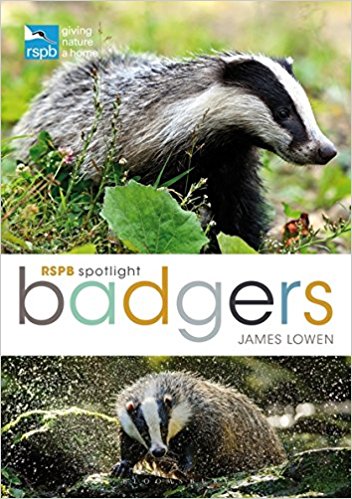 |
James
Lowen explores the lives of badgers and their communal
living, feeding habits and threats to their conservation. Click
here to buy:
Paperback edition
Kindle edition
|
|