 |
www.badgerland.co.uk |
| About how badgers live their lives across the UK |
| Home | Shop | Animals | Pictures | Help | Seeing | Groups | Education | News | Search | Books |
| Intro | Family | Food | Lifestyle | Size | Sounds | Threats | Diary | Latin | Setts | Evidence | Habitat | Legal | FAQ |
|
|
|
Lifestyle
Social GroupsAs a general rule, badgers live in sociable groups (clans) of 2-20 adults (although about six is more usual). Whilst many members of the clan take part in digging the sett and collecting/refreshing bedding materials, they are not really a highly co-operative species. They seem happy to live together in communal spaces, but otherwise they spend a lot of time doing their own thing. Unlike other members of the mustelid family that live in highly social family groups, badgers show relatively few signs of co-operative behaviour. In many cases, the formation of clans seems to be a product of areas which have a good food supply and a high badger density. In those areas where food is more of a problem and badger densities are lower, it is more common to find badgers living as a much smaller clan; or even as a pair. Also, badgers rarely have any concept of being routinely generous to other clan members; such as if they are struggling with parenthood or if there is a threat above ground. It seems to be a rare occurence that a non-breeding sow will provide help to a breeding sow. You do find instances of non-breeding sows chasing off predators (such as dogs and foxes); but the evidence that they are doing this to protect the cubs of another female seems ambiguous at best. If a badger senses danger above ground, it will often race back to the sett; without any action which could be interpreted as giving out a warning to other badgers or their cubs which may be nearby. There have been a few observations which suggest that females relatives may "baby-sit" related cubs for short periods or shepherd young cubs back to a sett; although there seem to be no plausible reports of sows suckling or otherwise providing food for cubs that are not their own. That said, badger sows will try to protect and defend their own cubs.
Affiliate GroupsThere is some evidence that, especially in larger clans, there may be 'tiers' of affiliations between different clan members. For example, sows sometimes show a preference for sharing sleeping chambers with other females, and sub-adult boars have been observed to form 'loose associations', spending more time with each other than other clan members. On some occasions one or more badgers will disperse from a clan and go to a near neighbour clan. It is possible that small affiliations of two or three females will disperse to a neighbouring clan together. Grooming and Scent MarkingThe main exceptions seem to be mutual grooming and scent marking. Grooming is where badgers try to rid themselves of parasites in their fur (such as fleas and lice). They will comb their own fur with their claws; as well as trying to nip any insects to death by biting at their own fur. One badger will sometimes help to groom other badlers by going through the other badgers fur with their muzzle. Scent marking is where badgers leave a scent on the ground and on each other. The process by which badgers scent mark each other is also known as allo-marking. The badger has a pouch under the tail which contains an oily musk; and is tries to smear this on to other badgers. Pretty much all badgers will perform this action to some degree; but all badgers in the clan will be marked by the dominant boar. Hence, each clan of badgers will have a common group odour plus their own personal odour. As badgers have an excellent sense of small, this process help badgers recognize other clan members as well as each other. Dominant boars are especially well placed to sense whether other males may be a threat; as they may well smell "boar-like" and may be missing the group scent. Such unmarked boars may be at risk of attack by the home dominant boar. Female badgers are much less likely to be attacked by other badgers. It is probably for this reason that both male and female cubs tend to have a scent which is much more like that of sows; as this would reduce the chance of being attacked by an agressive boar. TunnelsThe badgers dig out and live in a maze of underground tunnels and chambers called a sett. Badgers will enlarge tunnels every few metres to form convenient passing places or nesting chambers. The main sett is occupied all year round and is a permanent home. Many such badger setts are known to be around 100 years old. Around each main sett in the badgers territory/home range. There may well be other subsidiary setts that are used sporadically throughout the year, often between January and March when the cubs are born. Badgers like to build their setts into sloping ground in woodlands, especially where the drainage is good and the soil is not too heavy to dig. Sandy soil seems to be well-liked, and heavy clay soils avoided. Badgers are rarely seen during the day, and forage for food mainly at night. Their favourite foods are earthworms, insects and other creepy crawlies, roots, bulbs and tubers, fruit and berries. They may on occasion catch a young rabbit or even a frog. They are powerfully built animals. The male (called a boar), weighing up to 12 kilos, is slightly larger than the female (called a sow). Breeding SowsFrequently only one female badger (called a sow) in a social group breeds, although occasionally two or more may do so. The number of breeding sows is somewhat dependent on the female hierarchy and the number of females within the clan. Smaller clans (such as those in areas of low badger densitites) will tend to have just one breeding sow. In those areas with high badger densities, it is possible that thare are enough highly dominant females so that two (or in extreme cases three) sows will produce cubs in a year. In such large clans, there will be female-female competition amongst the sows to achieve breeding status. Such competition is not a purely badger-related activity; as there needs to be enough food within the territory to feed all the badgers. Based on the female reproduction (delayed implantation); it would be very rare for badgers to breed in such numbers that it resulted in mass starvation. The limited number of breeding sows explains to some degree why badger populations can be decimated so quickly - if cubs from two or three successive years fail to reach adulthood, the badger clan can be on the brink of extinction. Sadly too, badgers suffer from stress, and this can result in pregnant sows losing their unborn cubs. Activities such as digging out a sett, aggressive dogs in the sett, building works and other obvious nuisances can result in serious stress and badger cubs dying. Winter Torpor (not Hibernation)Whilst badgers do not hibernate in the winter, they do become slower and less active. This usually starts from late November and lasts for a few weeks - perhaps until the early spring. This is known as a winter "torpor", and is characterised by having a few sleepy days and lazy nights, as opposed to a recognised hibernation. During this period, badgers will emerge only to use their latrines and get the minimum of food, bedding, scent marking and territorial patrolling. The winter torpur may be a very important period for sows; as it may help make sure that any fertilized embryos start to develop beyond the first few cells. Bedding Materials
Female badgers may be especially keen to gather suitable bedding materials in the run up to the depths of winter; as they may be undergoing a winter torpor; and they may need lots of high-quality bedding if any cubs were to be born. Litters of two or three cubs are usually born in or around February - although there is some evidence that cubs are born later the further north or the higher up you go in the UK. It has been known (although very rare), that cubs can be born as early as December or as late as March.
|
![Badger Encounters in the Wild Jim Crumley [Book]](../../images/badger_encounters_in_the_wild.jpg)

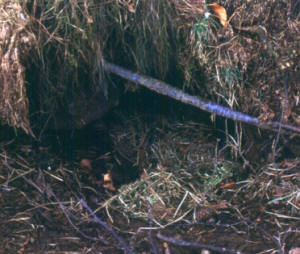 Badgers are exceptionally clean living animals, and will refresh
their bedding materials every few days. Bedding materials will
normally be grass, moss, leaves and so on. This provides a soft
mattress to provide insulation from the cold ground, and to reduce
draughts in the nesting chamber. Some of the material they select
may be fresh and green; as this can give off heat as it starts to decompose in
the nesting chambers. In some cases, badgers will gather other materials too.
The presence of green pine cones seems to occur more frequently than random
chance; and it is argued that the pine smell deters parasites from remaining in
the bedding materials. You may also find "litter-type" materials in the bedding
- this sometimes including bits of string (perhaps baler twine from hay bales),
pieces of plastic, etc.
Badgers are exceptionally clean living animals, and will refresh
their bedding materials every few days. Bedding materials will
normally be grass, moss, leaves and so on. This provides a soft
mattress to provide insulation from the cold ground, and to reduce
draughts in the nesting chamber. Some of the material they select
may be fresh and green; as this can give off heat as it starts to decompose in
the nesting chambers. In some cases, badgers will gather other materials too.
The presence of green pine cones seems to occur more frequently than random
chance; and it is argued that the pine smell deters parasites from remaining in
the bedding materials. You may also find "litter-type" materials in the bedding
- this sometimes including bits of string (perhaps baler twine from hay bales),
pieces of plastic, etc.