 |
www.badgerland.co.uk |
| About how badgers live their lives across the UK |
| Home | Shop | Animals | Pictures | Help | Seeing | Groups | Education | News | Search | Books |
| Intro | Family | Food | Lifestyle | Size | Sounds | Threats | Diary | Latin | Setts | Evidence | Habitat | Legal | FAQ |
|
|
|
Cubs
After the female badgers have given birth in or around February, there is a competition to ensure the survival of the cub or cubs. There are most commonly three cubs in a litter. However, it is not unusual for a female to have just one cub. Occasionally, litters of four or even five cubs are born, though it will be unusual if more than two cubs survive from a larger litter. In many litters the smaller cub may not survive for more than a few weeks if food or water is scarce; and very sadly some cubs may die underground before they have emerged from the nesting chamber. New-born cubs are thin and about 12cm (5.5 inches long) with a light covering of dirty-white or silvery grey fur and weigh about 75-130g. This fur is a little darker on the legs, and sometimes there are faint stripes on the face. All cubs have stripes on their faces within a few days of being born. It is belived that the majority of cubs are born in a specially modified nursing chamber, which is usually close to the entrance. This will usually have good airflow and a mass of high-quality bedding that is moved in by the pregnant sow prior to giving birth. On rare occasions (such as a subordinate sow being pregnant), the nursing chamber may be in a smaller sett, or even a large mound of straw or hay or otherwise well away from the attention of a more dominant pregnant sow. The cubs have their eyes closed at first. They develop their first teeth at about four weeks old. Their eyes do not open until they are five weeks old. Even then, they cannot see properly for a few more weeks, although as they live in a dark, underground chamber, there is not much for them to see anyway! When they are around 6 to 7 weeks old, the cubs start exploring the tunnels of their sett. At 8 weeks old, they may come up to the sett entrances. However, they do not usually start exploring outside the sett until they are nine to ten weeks old. Even then, they like to stay close to their mother, and they do not go very far from the sett entrances. This will usually be in late April or early May.
Mother badgers suckle their young for about 12 weeks or so (normally until around the end of May in the UK). After this, weaning starts - the mothers suckle the cubs less and less. The hungry cubs then have to start finding their own food. If is often possible to tell whether a sow has cubs, if the teats are prominent between February and the end of May. To begin with, the cubs follow their mother when she goes searching for food (foraging). They soon learn what's good to eat, and how find food for themselves. By the time they are 15 weeks old, the cubs are quite happy to go foraging alone; and by 16 weeks they will normally have their permanent adult teeth. By the time cubs are fully weaned, the cubs may weight about 6 kilos (if food availability is good). Badger PlayBadger cubs are very playful. They often play-fight and chase each other to and fro. A popular game is "tag" when the cubs chase each other around a tree trunk or in and out of holes. Cubs also use old logs or steep banks to play a type of "king-of-the-castle", where one cub takes up a higher position and the others try to dislodge it. Whilst appearing to be pure playfulness, the games fulfill a very useful function in life. Badger cub play helps to develop co-ordination, and strengthen muscles; and it helps to establish a sort of pecking order in terms of strength and seniority within the young clan members. By the autumn, badger cubs are nearly as big as adult badgers. They play much less now, and spend more time eating. They need to build up their body fat so that they will survive their first winter, when there isn't so much food around. If they live through the winter, they have a good chance of growing into fully adult badgers, and having cubs of their own. If the cub survives to the end of its first year, it will usually weigh between eight and ten kilograms (19 – 22 lbs) and measure 70 to 80cm (2.5 ft). Cub and Adult SurvivalGenerally, about half the cubs will die within their first year through causes other than infanticide (i.e. starvation, the weather, disease, infanticide, road traffic accidents, etc.). So far as cubs are concerned, the most important reason seems to be the weather; especially the rainfall levels. Around Oxford in 1990, this was a very dry summer with little rain. This meant that scientists observed 15 out of 23 observed cubs (65%) dying by the end of this dry summer. The hot dry weather made earthworms more scarce and difficult to dig for, leading to a reduction of overall body condition and an increased risk of cub death. The dry weather had little effect on the adult survival. Cubs experienced much higher survival rates in 1989 and 1991, so it seems clear that the rainfall was a vitally important factor.
|
![Badger Encounters in the Wild Jim Crumley [Book]](../../images/badger_encounters_in_the_wild.jpg)

 By early May, the cubs have grown to weigh around 3 kilos,
and look like smaller versions of adult badgers. Their muzzles are
shorter though, and like most young mammals, they are still quite
fluffy-looking and very cute to look at!
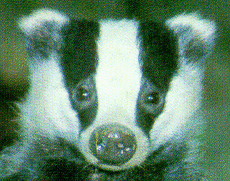
By early May, the cubs have grown to weigh around 3 kilos,
and look like smaller versions of adult badgers. Their muzzles are
shorter though, and like most young mammals, they are still quite
fluffy-looking and very cute to look at!